Abstract
This research conducts structural analysis of Matsuo Bashō's haiku using the C4 model (Context, Containers, Components, Code) employed in system design, integrated with Yamada Yōko's narrative theory. We analyze two representative haiku: "Kitsutsuki mo an wa yarazu natsu kodachi" (木啄きも庵は破らず夏木立) and "Aki suzushi te goto ni muke ya uri nasubi" (秋涼し手毎にむけや瓜茄子). The analysis focuses on the multi-layered examination of natural coexistence, temporal continuity, and the inclusive power of natural spaces. Specifically, we elucidate the cognitive development from natural actions to structural protection and environmental integration, and the structural mechanisms of "monogatari" (narrative) created through collaborative generation between the "narrator" and "listener."
Keywords
Haiku Analysis, Matsuo Bashō, Narrative Theory, Monogatari, C4 model, Natural Coexistence, Temporal Continuity, Environmental Inclusion
1. Introduction
1.1. Overview of Narrative Theory
Yamada Yōko's narrative theory expresses the conventional concept of "narrative" through the unique Japanese term "monogatari" (written in hiragana as "ものがたり"), clarifying its essential characteristics.
By writing "mono" in hiragana, Yamada
emphasizes that narrative is not merely narrated content (nominal elements) but a dynamic concept that includes the verbal act of "narrating," establishing a theoretical framework that has gained increasing attention in contemporary narrative studies
| [10] | Nguyen, Hong-Nguyen (Gwen), and Marlene Asselin. "An analysis of haiku teaching discourse: From talking about to doing haiku." Language and Literacy 21, no. 2 (2019): 16-34. |
[10]
.
The core of narrative theory lies in collaborative generation between the "narrator" and "listener." This means that narration is not unidirectional information transmission but a bidirectional process where narrator and listener create meaning through interaction.
In this collaborative generation process, the narrator's experience and listener's interpretation merge, creating new meaning worlds.
Recent research in digital humanities has explored similar collaborative meaning-making processes in computational literary analysis
| [11] | Eve, Martin Paul. The Digital Humanities and Literary Studies. Cambridge: Open Book Publishers, 2022. |
| [12] | Rebora, Simone. "Sentiment Analysis in Literary Studies: A Critical Survey." Digital Humanities Quarterly 17, no. 2 (2023). |
[11, 12]
.
1.2. Background and Meaning of the Haiku
1.2.1. "Kitsutsuki mo an wa yarazu natsu kodachi" (木啄きも庵は破らず夏木立)
This haiku was composed by Bashō
| [2] | Matsuo, B. Haikai-shū (Haikai Collection). Tokyo: Iwanami Bunko; 1982. |
[2]
during his journey described in "Oku no Hosomichi" (The Narrow Road to the Deep North).
Contemporary scholarship continues to reveal new dimensions of Bashō's work, with recent translations emphasizing the collaborative and open-ended nature of his compositions
| [13] | Fitzsimons, Andrew (trans.). Bashō: The Complete Haiku of Matsuo Bashō. Berkeley: University of California Press, 2024. |
[13].
Through natural observation at Risshakuji (Yamadera), he captured the situation where natural creatures (woodpeckers) coexist with artificial structures (hermitage) without destruction, within the rich summer forest environment (natsu kodachi).
The meaning of this verse is "The woodpecker does not break the hermitage, harmonizing within the summer grove."
The characteristic feature of this verse lies in the cognitive development from natural action (woodpecker) to protective relationship (does not break the hermitage) to environmental integration (summer grove).
1.2.2. "Aki suzushi te goto ni muke ya uri nasubi" (秋涼し手毎にむけや瓜茄子)
This haiku was composed during Bashō's journey in "Oku no Hosomichi." It expresses the transition of seasons and the reality of life through the daily act of peeling melons and eggplants during autumn harvest time.
"Aki suzushi" expresses the cognitive foundation through seasonal perception, "te goto ni muke ya" means practical integration through bodily actions and the repetitive nature of actions, and "uri nasubi" indicates life integration through harvest experience and experiential integration through unity with nature's bounty.
The meaning is "Feeling the autumn coolness, let us peel them one by one in our hands, melons and eggplants."
2. Significance of Applying Narrative Theory to Haiku Criticism
2.1. Haiku Experience as Collaborative Generation
By applying narrative theory to haiku analysis, it becomes clear that haiku is not merely an expression by the author but a dynamic system that creates meaning through collaborative generation with readers.
In Bashō's haiku
| [2] | Matsuo, B. Haikai-shū (Haikai Collection). Tokyo: Iwanami Bunko; 1982. |
| [6] | Ogata, T. Interpretation and Appreciation of Haiku. Tokyo: Kadokawa Shoten; 1995. |
[2, 6]
, the narrator's (Bashō's) natural observation experience merges with the listener's (reader's) interpretation, collaboratively generating the "monogatari" of natural coexistence.
This collaborative framework aligns with emerging digital humanities approaches to literary interpretation that emphasize reader participation and meaning co-creation
| [14] | Röttgermann, Julia, Keli Du, Julia Havrylash, and Christof Schöch. "Expertise and statistics: Evaluation of measures of distinctiveness for the analysis of literary subgenres." Digital Humanities Quarterly 19, no. 1 (2025). |
| [15] | Vanathi, A. "Exploring Literary Studies through Digital Humanities." TAALIMIA Review 8, no. 3 (2023): 203-218. |
[14, 15]
.
2.2. Polyphonic Narrative Structure
The "woodpecker," "hermitage," and "summer grove" in this verse function as narrators with different voices.
The woodpecker narrates the dynamic elements of the natural world, the hermitage narrates artificial static elements, and the summer grove narrates inclusive environmental elements. These polyphonic narratives are integrated through collaborative generation with readers, creating a harmonious "monogatari."
3. Significance of Analyzing Haiku Criticism with UML-C4 Model
3.1. Systems Thinking Approach
By applying the hierarchical analysis method of the C4 model
| [3] | Brown, S. The C4 model for visualising software architecture. London: Leanpub; 2018. Available from: https://c4model.com (Accessed 6 December 2025). |
[3]
to haiku, the following structural characteristics can be clarified:
1) Natural Coexistence Integration System:
Three-stage coexistence cognitive process from woodpecker → does not break hermitage → summer grove
2) Protective Relationship Symbol System:
Hierarchical protection function from animal (woodpecker) → structure (hermitage) → environment (summer grove)
3) Temporal Continuity Function:
Time axis system from negation of destructive acts to continuous harmony
4) Environmental Inclusion Acceptance System:
Diversity integration mechanism through the inclusiveness of summer grove
The application of software architecture models to literary analysis represents an innovative interdisciplinary approach, reflecting broader trends in digital humanities where computational thinking enhances traditional literary criticism
.
3.2. Integration of Narrative × System Analysis
By integrating narrative theory with the C4 model, the "monogatari" structure of haiku can be systematically visualized.
This enables systematic analysis of how the collaborative generation process between narrator and listener functions at each hierarchical level. Such visualization techniques have proven valuable in recent computational approaches to narrative structure analysis
| [18] | Proceedings of the 4th International Conference on Natural Language Processing for Digital Humanities. Association for Computational Linguistics, 2024. |
[18]
.
4. Overview of Each C4 Model Level
4.1. Context Level
For "Kitsutsuki mo an wa yarazu natsu kodachi":
1) External Environment:
Summer forest, Risshakuji (Yamadera), Oku no Hosomichi journey, Edo period natural coexistence philosophy
2) Central System:
Haiku "Kitsutsuki mo an wa yarazu natsu kodachi"
3) Users:
Readers, natural observers, coexistence seekers, people seeking harmony
4) Cultural Context:
Natural coexistence philosophy, environmental harmony aesthetics, aspiration for non-destructive relationships
For "Aki suzushi te goto ni muke ya uri nasubi":
1) External Environment:
Autumn harvest season, daily life environment, Oku no Hosomichi journey, natural blessing experience environment
2) Central System:
Haiku "Aki suzushi te goto ni muke ya uri nasubi"
3) Users:
Readers, life experiencers, harvest experience recipients, seasonal experiencers
4) Cultural Context:
Seasonal recognition and harvest experience expression dialogue, life practice expression, pursuit of experiential integration
4.2. Container Level
Verse Structure for "Kitsutsuki mo an wa yarazu natsu kodachi":
1) Upper verse: "Kitsutsuki mo" (natural animal・dynamic element)
2) Middle verse: "an wa yarazu" (artificial structure・protective relationship・negative expression)
3) Lower verse: "natsu kodachi" (environmental inclusion・seasonal space)
Verse Structure for "Aki suzushi te goto ni muke ya uri nasubi":
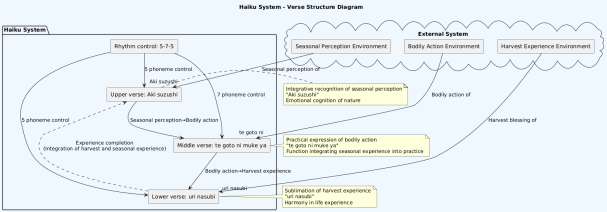
1) Upper verse: "Aki suzushi" (seasonal perception・environmental recognition)
2) Middle verse: "te goto ni muke ya" (bodily action・practical integration)
3) Lower verse: "uri nasubi" (harvest experience・life sublimation)
4.3. Component Level
Natural Coexistence Integration System:
1) Natural Animal Recognition: Recognition of dynamic existence of forest creatures through "Kitsutsuki mo"
2) Protective Relationship Integration: Non-destructive coexistence expression through the act of not breaking the hermitage
3) Environmental Inclusion Generation: Integration with inclusive environment through summer grove
4) Natural-Artificial Harmony: Harmonious integration of natural, artificial, and environmental elements
Life Sublimation System:
1) Seasonal Perception Recognition: Integrative recognition of natural experience cognition through "Aki suzushi"
2) Bodily Action Generation: Practical function and experiential integration through "te goto ni muke ya"
3) Harvest Experience Recognition: Completion of integration with life cognition through "uri nasubi"
4) Life Experience Harmony: Harmonious integration of seasonal perception, bodily action, and harvest experience
5. PlantUML Structure Diagrams
5.1. Context Diagram for "Kitsutsuki mo an wa yarazu natsu kodachi"
@startuml HaikuNarrativeContext_Kitsutsuki
skinparam componentStyle rectangle
skinparam backgroundColor #E6F3FF
title Haiku Narrative System - Context Diagram "Kitsutsuki mo an wa yarazu natsu kodachi"
actor "Reader・Natural Observer・Coexistence Seeker" as reader
rectangle "Haiku Narrative System" as haiku_system {
[Kitsutsuki mo an wa yarazu natsu kodachi]
}
cloud "Natural Coexistence Environment System" as environment {
[Natural Coexistence Philosophy] as coexistence_culture
[Environmental Harmony Aesthetics] as harmony_aesthetics
[Non-destructive Relationship] as non_destructive
[Animal Behavior Observation] as animal_behavior
[Structure Protection] as structure_protection
[Environmental Inclusion Power] as environmental_inclusion
[Polyphonic Narrative] as polyphonic_voice
[Collaborative Generation] as co_creation
}
reader --> haiku_system: Participate in collaborative generation
haiku_system <-- coexistence_culture: Foundation of coexistence philosophy
haiku_system <-- harmony_aesthetics: Culture of harmony aesthetics
haiku_system <-- non_destructive: Expression of non-destructive relationship
haiku_system <-- animal_behavior: Observation of animal behavior
haiku_system <-- structure_protection: Concept of structure protection
haiku_system <-- environmental_inclusion: Function of environmental inclusion
haiku_system <-- polyphonic_voice: Structure of polyphonic narrative
haiku_system <-- co_creation: Principle of collaborative generation
environment --> reader: Sharing coexistence experience
note right of haiku_system
Voice of woodpecker as natural animal
Narrative of protective relationship "does not break hermitage"
Expression of environmental inclusion "summer grove"
Creation of natural coexistence "monogatari"
through polyphonic narrative collaborative generation
end note
@enduml
5.2. Container Diagram for "Aki suzushi te goto ni muke ya uri nasubi"
@startuml HaikuNarrativeContainer_UriNasu
skinparam componentStyle rectangle
skinparam backgroundColor #F0F8FF
title Haiku System - Verse Structure Diagram
package "Haiku System" {
[Upper verse: Aki suzushi] as upper
[Middle verse: te goto ni muke ya] as middle
[Lower verse: uri nasubi] as lower
[Rhythm control: 5-7-5] as rhythm
}
cloud "External System" {
[Seasonal Perception Environment] as season_environment
[Bodily Action Environment] as body_environment
[Harvest Experience Environment] as harvest_environment
}
rhythm --> upper: 5 phoneme control
rhythm --> middle: 7 phoneme control
rhythm --> lower: 5 phoneme control
upper --> middle: Seasonal perception→Bodily action
middle --> lower: Bodily action→Harvest experience
lower..> upper: Experience completion\n(Integration of harvest and seasonal experience)
season_environment --> upper: Seasonal perception of "Aki suzushi"
body_environment --> middle: Bodily action of "te goto ni"
harvest_environment --> lower: Harvest blessing of "uri nasubi"
note right of upper
Integrative recognition of seasonal perception
"Aki suzushi"
Emotional cognition of nature
end note
note right of middle
Practical expression of bodily action
"te goto ni muke ya"
Function integrating seasonal experience into practice
end note
note right of lower
Sublimation of harvest experience
"uri nasubi"
Harmony in life experience
end note
@enduml
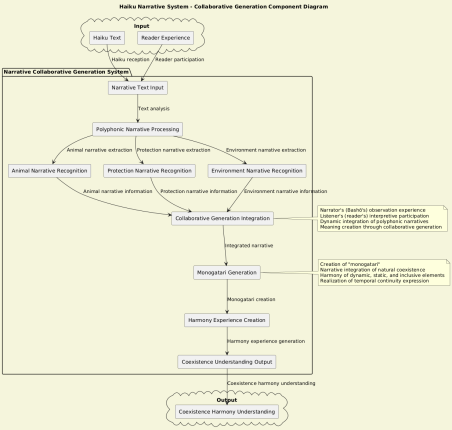
5.3. Component Diagram - Narrative Collaborative Generation Processing
@startuml HaikuNarrativeComponent_Kitsutsuki
skinparam componentStyle rectangle
skinparam backgroundColor #F5F5DC
title Haiku Narrative System - Collaborative Generation Component Diagram
package "Narrative Collaborative Generation System" {
[Narrative Text Input] as text_input
[Polyphonic Narrative Processing] as polyphonic_processing
[Animal Narrative Recognition] as animal_narrative
[Protection Narrative Recognition] as protection_narrative
[Environment Narrative Recognition] as environment_narrative
[Collaborative Generation Integration] as cocreation_integration
[Monogatari Generation] as monogatari_generation
[Harmony Experience Creation] as harmony_experience
[Coexistence Understanding Output] as coexistence_output
}
cloud "Input" {
[Haiku Text] as input
[Reader Experience] as reader_experience
}
cloud "Output" {
[Coexistence Harmony Understanding] as output
}
input --> text_input: Haiku reception
reader_experience --> text_input: Reader participation
text_input --> polyphonic_processing: Text analysis
polyphonic_processing --> animal_narrative: Animal narrative extraction
polyphonic_processing --> protection_narrative: Protection narrative extraction
polyphonic_processing --> environment_narrative: Environment narrative extraction
animal_narrative --> cocreation_integration: Animal narrative information
protection_narrative --> cocreation_integration: Protection narrative information
environment_narrative --> cocreation_integration: Environment narrative information
cocreation_integration --> monogatari_generation: Integrated narrative
monogatari_generation --> harmony_experience: Monogatari creation
harmony_experience --> coexistence_output: Harmony experience generation
coexistence_output --> output: Coexistence harmony understanding
note right of cocreation_integration
Narrator's (Bashō's) observation experience
Listener's (reader's) interpretive participation
Dynamic integration of polyphonic narratives
Meaning creation through collaborative generation
end note
note right of monogatari_generation
Creation of "monogatari"
Narrative integration of natural coexistence
Harmony of dynamic, static, and inclusive elements
Realization of temporal continuity expression
end note
@enduml
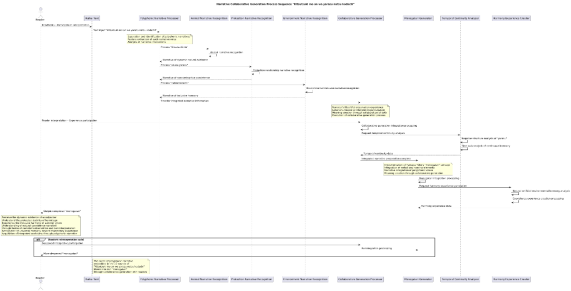
5.4. Cognitive Process Sequence Diagram
@startuml NarrativeSequence_Kitsutsuki
title Narrative Collaborative Generation Process Sequence "Kitsutsuki mo an wa yarazu natsu kodachi"
actor "Reader" as reader
participant "Haiku Text" as haiku_text
participant "Polyphonic Narrative Processor" as voice_processor
participant "Animal Narrative Recognition" as animal_voice
participant "Protection Narrative Recognition" as protection_voice
participant "Environment Narrative Recognition" as environment_voice
participant "Collaborative Generation Processor" as cocreation_processor
participant "Monogatari Generator" as monogatari_generator
participant "Temporal Continuity Analyzer" as temporal_analyzer
participant "Harmony Experience Creator" as harmony_creator
reader -> haiku_text: Read haiku・Participate in interpretation
haiku_text -> voice_processor: Text input "Kitsutsuki mo an wa yarazu natsu kodachi"
note over voice_processor
Separation and identification of polyphonic narratives
Feature extraction of each narrative voice
Analysis of narrative interactions
end note
voice_processor -> animal_voice: Process "Kitsutsuki mo"
animal_voice -> animal_voice: Animal narrative recognition
animal_voice --> voice_processor: Narrative of dynamic natural existence
voice_processor -> protection_voice: Process "an wa yarazu"
protection_voice -> protection_voice: Protection relationship narrative recognition
protection_voice --> voice_processor: Narrative of non-destructive coexistence
voice_processor -> environment_voice: Process "natsu kodachi"
environment_voice -> environment_voice: Environmental inclusion narrative recognition
environment_voice --> voice_processor: Narrative of inclusive harmony
voice_processor -> cocreation_processor: Transfer integrated narrative information
note over cocreation_processor
Narrator's (Bashō's) observation experience
Listener's (reader's) interpretive participation
Meaning creation through collaboration of both
Execution of collaborative generation process
end note
reader -> cocreation_processor: Reader interpretation・Experience participation
cocreation_processor -> cocreation_processor: Collaborative generation integration processing
cocreation_processor -> temporal_analyzer: Request temporal continuity analysis
temporal_analyzer -> temporal_analyzer: Negative structure analysis of "yarazu"
temporal_analyzer -> temporal_analyzer: Time axis analysis of continuous harmony
temporal_analyzer --> cocreation_processor: Temporal continuity data
cocreation_processor -> monogatari_generator: Integrated narrative preparation complete
note over monogatari_generator
Implementation of Yamada Yōko's "monogatari" concept
Integration of verbal and nominal elements
Narrative integration of polyphonic voices
Meaning creation through collaborative generation
end note
monogatari_generator -> monogatari_generator: Monogatari integration processing
monogatari_generator -> harmony_creator: Request harmony experience generation
harmony_creator -> harmony_creator: Natural-artificial-environmental harmony analysis
harmony_creator -> harmony_creator: Coexistence experience creation processing
harmony_creator --> monogatari_generator: Harmony experience data
monogatari_generator --> reader: Output completed "monogatari"
note over reader
Perceive the dynamic existence of woodpecker
Understand the protected stability of hermitage
Experience the inclusive harmony of summer grove
Understanding of natural coexistence narrative
through fusion of narrator's observation and own interpretation
Recognition of universal harmony beyond momentary experience
Acquisition of integrated worldview through polyphonic narrative
end note
alt Reader's reinterpretation cycle
reader -> cocreation_processor: Deepened interpretive participation
cocreation_processor -> monogatari_generator: Re-integration processing
monogatari_generator --> reader: More deepened "monogatari"
end
note right of haiku_text
The seeds of polyphonic narrative
embedded in the 17 sounds of
"Kitsutsuki mo an wa yarazu natsu kodachi"
bloom into rich "monogatari"
through collaborative generation with readers
end note
@enduml
6. Code Implementation Example
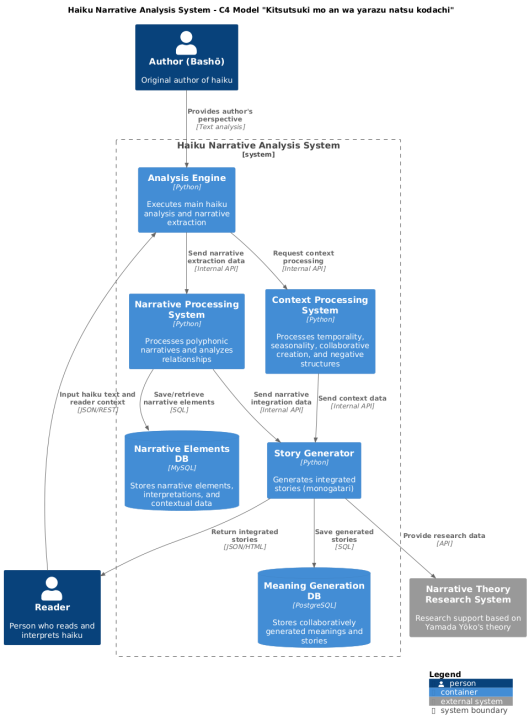
6.1. Haiku Narrative Analysis System - C4 Model
@startuml HaikuNarrativeC4Model
!include <C4/C4_Container>
!include <C4/C4_Component>
title Haiku Narrative Analysis System - C4 Model "Kitsutsuki mo an wa yarazu natsu kodachi"
Person(reader, "Reader", "Person who reads and interprets haiku")
Person(author, "Author (Bashō)", "Original author of haiku")
System_Boundary(haiku_system, "Haiku Narrative Analysis System") {
Container(analyzer_container, "Analysis Engine", "Python", "Executes main haiku analysis and narrative extraction")
Container(generator_container, "Story Generator", "Python", "Generates integrated stories (monogatari)")
Container(processor_container, "Narrative Processing System", "Python", "Processes polyphonic narratives and analyzes relationships")
Container(context_container, "Context Processing System", "Python", "Processes temporality, seasonality, collaborative creation, and negative structures")
ContainerDb(narrative_db, "Narrative Elements DB", "MySQL", "Stores narrative elements, interpretations, and contextual data")
ContainerDb(meaning_db, "Meaning Generation DB", "PostgreSQL", "Stores collaboratively generated meanings and stories")
}
System_Ext(research_system, "Narrative Theory Research System", "Research support based on Yamada Yōko's theory")
' Level 2 - Container relationships
Rel(reader, analyzer_container, "Input haiku text and reader context", "JSON/REST")
Rel(author, analyzer_container, "Provides author's perspective", "Text analysis")
Rel(analyzer_container, processor_container, "Send narrative extraction data", "Internal API")
Rel(analyzer_container, context_container, "Request context processing", "Internal API")
Rel(processor_container, generator_container, "Send narrative integration data", "Internal API")
Rel(context_container, generator_container, "Send context data", "Internal API")
Rel(processor_container, narrative_db, "Save/retrieve narrative elements", "SQL")
Rel(generator_container, meaning_db, "Save generated stories", "SQL")
Rel(generator_container, reader, "Return integrated stories", "JSON/HTML")
Rel(generator_container, research_system, "Provide research data", "API")
SHOW_LEGEND()
@enduml
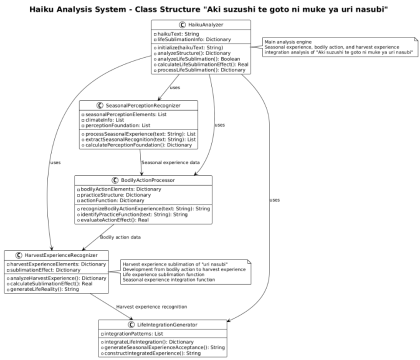
6.2. System Structure Class Diagram
@startuml HaikuAnalyzerClass_UriNasu
!theme plain
title Haiku Analysis System - Class Structure "Aki suzushi te goto ni muke ya uri nasubi"
class HaikuAnalyzer {
- haikuText: String
- lifeSublimationInfo: Dictionary
+ initialize(haikuText: String)
+ analyzeStructure(): Dictionary
+ analyzeLifeSublimation(): Boolean
+ calculateLifeSublimationEffect(): Real
+ processLifeSublimation(): Dictionary
}
class SeasonalPerceptionRecognizer {
- seasonalPerceptionElements: List
- climateInfo: List
- perceptionFoundation: List
+ processSeasonalExperience(text: String): List
+ extractSeasonalRecognition(text: String): List
+ calculatePerceptionFoundation(): Dictionary
}
class BodilyActionProcessor {
- bodilyActionElements: Dictionary
- practiceStructure: Dictionary
- actionFunction: Dictionary
+ recognizeBodilyActionExperience(text: String): String
+ identifyPracticeFunction(text: String): String
+ evaluateActionEffect(): Real
}
class HarvestExperienceRecognizer {
- harvestExperienceElements: Dictionary
- sublimationEffect: Dictionary
+ analyzeHarvestExperience(): Dictionary
+ calculateSublimationEffect(): Real
+ generateLifeReality(): String
}
class LifeIntegrationGenerator {
- integrationPatterns: List
+ integrateLifeIntegration(): Dictionary
+ generateSeasonalExperienceAcceptance(): String
+ constructIntegratedExperience(): String
}
HaikuAnalyzer --> SeasonalPerceptionRecognizer: uses
HaikuAnalyzer --> BodilyActionProcessor: uses
HaikuAnalyzer --> HarvestExperienceRecognizer: uses
HaikuAnalyzer --> LifeIntegrationGenerator: uses
SeasonalPerceptionRecognizer --> BodilyActionProcessor: Seasonal experience data
BodilyActionProcessor --> HarvestExperienceRecognizer: Bodily action data
HarvestExperienceRecognizer --> LifeIntegrationGenerator: Harvest experience recognition
note right of HaikuAnalyzer
Main analysis engine
Seasonal experience, bodily action, and harvest experience
integration analysis of "Aki suzushi te goto ni muke ya uri nasubi"
end note
note right of HarvestExperienceRecognizer
Harvest experience sublimation of "uri nasubi"
Development from bodily action to harvest experience
Life experience sublimation function
Seasonal experience integration function
end note
@enduml
7. Analysis Results and Discussion
7.1. Narrative Structural Characteristics
Through narrative theory
| [1] | Yamada, Yōko. Narrative Research: Collaborative Generation of Stories (Yamada Yōko Collected Works). Amazon Publishing. https://www.amazon.co.jp/dp/4788517035 |
| [8] | Noguchi, Y. Narrative Approach. Tokyo: Keisō Shobō; 2009. |
[1, 8]
× C4 model
| [3] | Brown, S. The C4 model for visualising software architecture. London: Leanpub; 2018. Available from: https://c4model.com (Accessed 6 December 2025). |
[3]
analysis, the following characteristics of these haiku have been revealed:
For "Kitsutsuki mo an wa yarazu natsu kodachi":
1. Polyphonic Narrative Structure:
Triple narrative of woodpecker (dynamic natural narrative), hermitage (static artificial narrative), and summer grove (inclusive environmental narrative)
2. Collaborative Generation Function:
Dynamic meaning creation through Bashō's natural observation and reader's interpretive participation
3. Affirmation through Negative Expression:
Emphatic expression of coexistence relationship through the negative form "yarazu" (does not break)
4. Temporal Continuity Integration:
Time axis expression of harmony through continuous non-destructive relationships
5. Environmental Inclusion Completion:
Realization of overall integration and inclusive harmony through summer grove
For "Aki suzushi te goto ni muke ya uri nasubi":
1. Life Sublimation Structure:
Staged process from seasonal perception (aki suzushi) → bodily action (te goto ni muke ya) → harvest experience sublimation (uri nasubi)
2. Experience Integration Acceptance Structure:
Experience layer expression from seasonal experientiality to bodily action practicality
3. Life Affirmation Structure:
Presentation of harvest experience sublimation and integrated experience expression through "uri nasubi"
4. Harvest Experience Completion Structure:
Life experiential expression integration through integration of seasonal experience continuity and harvest experience reality
7.2. Collaborative Generation Cognitive Mechanism
In the reader's cognitive process, the following Yamada's collaborative generation framework
and traditional haiku interpretation methods
| [6] | Ogata, T. Interpretation and Appreciation of Haiku. Tokyo: Kadokawa Shoten; 1995. |
| [7] | Konishi, J. The World of Haiku. Tokyo: Kodansha Gakujutsu Bunko; 1995. |
[6, 7]
, collaborative generation stages are generated:
For "Kitsutsuki mo an wa yarazu natsu kodachi":
1) Animal Narrative Acceptance:
Accept the woodpecker's dynamic existence in the forest as narrator
2) Protective Relationship Construction:
Construction of coexistence narrative through the act of not breaking the hermitage
3) Environmental Integration Participation:
Experience where the reader themselves participate in the inclusive power of summer grove
4) Harmony Narrative Completion:
Completion of coexistence harmony "monogatari" through collaboration between narrator and listener
5) Universal Coexistence Experience:
Acquisition of universal natural coexistence understanding beyond individual experience
For "Aki suzushi te goto ni muke ya uri nasubi":
1) Seasonal Experience Recognition Processing:
Understanding emotional recognition of seasonal perception through "Aki suzushi"
2) Bodily Action Recognition:
Grasping the effects of practical integration experience called "te goto ni muke ya"
3) Harvest Experience Recognition:
Perceiving life integration sublimation through "uri nasubi"
4) Life Integration Experience:
Understanding harmony where seasonal experience, bodily action, and harvest experience are integrated
5) Integrated Harmony Completion:
Experiencing the completeness of integrated view where seasonal experience and integrated experience coexist
7.3. Differentiation from Previous Research
While traditional haiku research
| [5] | Fukumoto, I. Bashō no Fūkei (Bashō's Landscapes). Tokyo: Iwanami Shinsho; 2005. |
| [6] | Ogata, T. Interpretation and Appreciation of Haiku. Tokyo: Kadokawa Shoten; 1995. |
| [7] | Konishi, J. The World of Haiku. Tokyo: Kodansha Gakujutsu Bunko; 1995. |
[5-7]
has focused on the natural depiction and seasonal feeling of these verses, the narrative theory × C4 model analysis makes clearer their function as dynamic meaning generation systems with reader participation.
Particularly, the innovative function as "monogatari" creation systems through collaborative work between narrator and listener, rather than mere natural observation poetry, has been elucidated.
This approach resonates with contemporary digital humanities methodologies that employ computational models to reveal structural patterns in literary works
.
8. Conclusion
Through the integrated application of narrative theory × C4 model, the complex mechanisms of polyphonic narrative and collaborative generation in both haiku have been systematically elucidated.
Particularly, the integrated understanding of verbal and nominal elements through Yamada Yōko's "monogatari" concept, and the meaning creation process through collaborative generation between narrator and listener, could be clearly analyzed at each C4 hierarchical level.
This analysis method has been confirmed effective for understanding the dynamic meaning generation, reader participation, and polyphonic narrative structures of haiku, demonstrating the applicability of narrative psychological approaches to literary research.
Our interdisciplinary framework contributes to emerging scholarship at the intersection of computational methods and traditional literary criticism
.
9. Future Development Possibilities
9.1. Comparative Analysis Research
1) Comparative narrative analysis with other natural coexistence-related haiku
2) Contrast of collaborative generation patterns in Bashō's polyphonic narrative techniques
3) AI-generated haiku research using computational methods
| [9] | Hitsuwari, Jimpei, Yoshiyuki Ueda, Woojin Yun, and Michio Nomura. "Does human–AI collaboration lead to more creative art? Aesthetic evaluation of human-made and AI-generated haiku poetry." Computers in Human Behavior 139 (2023): 107502. https://doi.org/10.1016/j.chb.2022.107502 |
| [19] | Hitsuwari, Jimpei, et al. "A Framework for Haiku Generation from a Narrative." Atlantis Press Journals, June 25, 2019. |
[9, 19]
provides comparative perspectives on human-machine collaborative creativity in haiku composition.
9.2. Educational Applications
1) Development of collaborative generation-type haiku appreciation materials
2) Literary experience support systems through narrative participation
9.3. Psychological Applications
1) Research on psychological mechanisms of collaborative generation in haiku experience
2) Elucidation of cognitive processes in polyphonic narrative reception
Author Contributions
Osamu Okumura is the sole author. The author read and approved the final manuscript.
Conflicts of Interest
The author declares no conflicts of interest.
References
| [1] |
Yamada, Yōko. Narrative Research: Collaborative Generation of Stories (Yamada Yōko Collected Works). Amazon Publishing.
https://www.amazon.co.jp/dp/4788517035
|
| [2] |
Matsuo, B. Haikai-shū (Haikai Collection). Tokyo: Iwanami Bunko; 1982.
|
| [3] |
Brown, S. The C4 model for visualising software architecture. London: Leanpub; 2018. Available from:
https://c4model.com
(Accessed 6 December 2025).
|
| [4] |
PlantUML Development Team. PlantUML: Open-source tool for creating UML diagrams. Available from:
https://www.plantuml.com/plantuml/uml/
(Accessed 6 December 2025).
|
| [5] |
Fukumoto, I. Bashō no Fūkei (Bashō's Landscapes). Tokyo: Iwanami Shinsho; 2005.
|
| [6] |
Ogata, T. Interpretation and Appreciation of Haiku. Tokyo: Kadokawa Shoten; 1995.
|
| [7] |
Konishi, J. The World of Haiku. Tokyo: Kodansha Gakujutsu Bunko; 1995.
|
| [8] |
Noguchi, Y. Narrative Approach. Tokyo: Keisō Shobō; 2009.
|
| [9] |
Hitsuwari, Jimpei, Yoshiyuki Ueda, Woojin Yun, and Michio Nomura. "Does human–AI collaboration lead to more creative art? Aesthetic evaluation of human-made and AI-generated haiku poetry." Computers in Human Behavior 139 (2023): 107502.
https://doi.org/10.1016/j.chb.2022.107502
|
| [10] |
Nguyen, Hong-Nguyen (Gwen), and Marlene Asselin. "An analysis of haiku teaching discourse: From talking about to doing haiku." Language and Literacy 21, no. 2 (2019): 16-34.
|
| [11] |
Eve, Martin Paul. The Digital Humanities and Literary Studies. Cambridge: Open Book Publishers, 2022.
|
| [12] |
Rebora, Simone. "Sentiment Analysis in Literary Studies: A Critical Survey." Digital Humanities Quarterly 17, no. 2 (2023).
|
| [13] |
Fitzsimons, Andrew (trans.). Bashō: The Complete Haiku of Matsuo Bashō. Berkeley: University of California Press, 2024.
|
| [14] |
Röttgermann, Julia, Keli Du, Julia Havrylash, and Christof Schöch. "Expertise and statistics: Evaluation of measures of distinctiveness for the analysis of literary subgenres." Digital Humanities Quarterly 19, no. 1 (2025).
|
| [15] |
Vanathi, A. "Exploring Literary Studies through Digital Humanities." TAALIMIA Review 8, no. 3 (2023): 203-218.
|
| [16] |
Chattopadhyay, Shubhadeep. "The C4 Model for Software Architecture Visualization Explained." Medium, May 21, 2024.
https://medium.com/@shubhadeepchat/the-c4-model-for-software-architecture-visualization-explained-93b85ea3e2e3
|
| [17] |
Cohen, Sheldon. "Understanding the C4 Model for Software Architecture Documentation." Medium, October 26, 2023.
https://sheldonrcohen.medium.com/understanding-the-c4-model-for-software-architecture-documentation-e59c4edd0d56
|
| [18] |
Proceedings of the 4th International Conference on Natural Language Processing for Digital Humanities. Association for Computational Linguistics, 2024.
|
| [19] |
Hitsuwari, Jimpei, et al. "A Framework for Haiku Generation from a Narrative." Atlantis Press Journals, June 25, 2019.
|
| [20] |
"Literary criticism in the age of digital humanities." Chinese Social Sciences Today, October 28, 2024.
http://english.cssn.cn/skw_research/literature/202410/t20241028_5797010.shtml
|
| [21] |
"Digital Humanities." Literary Theory and Criticism, September 5, 2024.
https://literariness.org/2024/09/05/digital-humanities/
|
Cite This Article
-
-
@article{10.11648/j.ellc.20251004.15,
  author = {Osamu Okumura},
  title = {Matsuo Bashō Haiku Analysis: Narrative Theory × C4 Model Structure Analysis},
  journal = {English Language, Literature & Culture},
  volume = {10},
  number = {4},
  pages = {160-171},
  doi = {10.11648/j.ellc.20251004.15},
  url = {https://doi.org/10.11648/j.ellc.20251004.15},
  eprint = {https://article.sciencepublishinggroup.com/pdf/10.11648.j.ellc.20251004.15},
  abstract = {This research conducts structural analysis of Matsuo Bashō's haiku using the C4 model (Context, Containers, Components, Code) employed in system design, integrated with Yamada Yōko's narrative theory. We analyze two representative haiku: "Kitsutsuki mo an wa yarazu natsu kodachi" (木啄きも庵は破らず夏木立) and "Aki suzushi te goto ni muke ya uri nasubi" (秋涼し手毎にむけや瓜茄子). The analysis focuses on the multi-layered examination of natural coexistence, temporal continuity, and the inclusive power of natural spaces. Specifically, we elucidate the cognitive development from natural actions to structural protection and environmental integration, and the structural mechanisms of "monogatari" (narrative) created through collaborative generation between the "narrator" and "listener."},
 year = {2025}
}
 Copy
|
Copy
|
 Download
-
TY  - JOUR
T1  - Matsuo Bashō Haiku Analysis: Narrative Theory × C4 Model Structure Analysis
AU  - Osamu Okumura
Y1  - 2025/12/26
PY  - 2025
N1  - https://doi.org/10.11648/j.ellc.20251004.15
DO  - 10.11648/j.ellc.20251004.15
T2  - English Language, Literature & Culture
JF  - English Language, Literature & Culture
JO  - English Language, Literature & Culture
SP  - 160
EP  - 171
PB  - Science Publishing Group
SN  - 2575-2413
UR  - https://doi.org/10.11648/j.ellc.20251004.15
AB  - This research conducts structural analysis of Matsuo Bashō's haiku using the C4 model (Context, Containers, Components, Code) employed in system design, integrated with Yamada Yōko's narrative theory. We analyze two representative haiku: "Kitsutsuki mo an wa yarazu natsu kodachi" (木啄きも庵は破らず夏木立) and "Aki suzushi te goto ni muke ya uri nasubi" (秋涼し手毎にむけや瓜茄子). The analysis focuses on the multi-layered examination of natural coexistence, temporal continuity, and the inclusive power of natural spaces. Specifically, we elucidate the cognitive development from natural actions to structural protection and environmental integration, and the structural mechanisms of "monogatari" (narrative) created through collaborative generation between the "narrator" and "listener."
VL  - 10
IS  - 4
ER  -
Copy
|
Download





 Share This Article
 Twitter
 Linked In
 Facebook